
Introduction
Google’s birthday is celebrated every year on September 27, marking one of the most recognizable dates in the history of the internet. What began as a research project by two Stanford University graduate students eventually developed into one of the most influential technology companies in the world. Google changed the way people search for information, communicate online, navigate cities, watch videos, use smartphones, store files, and interact with digital technology.
The story behind Google’s birthday is more complicated than it may first appear. Google Inc. was officially incorporated in September 1998, but the technology behind the search engine began several years earlier. Larry Page and Sergey Brin started working together on a research project at Stanford in 1996. Their early search engine was known as BackRub, and the project eventually developed into the Google search engine that people know today.
September 27 became the date associated with Google’s birthday, although the compan y has used different dates for birthday celebrations in its history. The Google.com domain was registered in September 1997, while the company itself was incorporated in September 1998. This difference is one reason why questions about the exact date of Google’s birthday sometimes appear online.
Google’s birthday is also connected with the company’s famous Google Doodles. These special changes to the Google logo have become a regular way for the company to celebrate important people, events, holidays, anniversaries, and cultural occasions. The first Doodle appeared in 1998, before Google was even officially incorporated, and the idea eventually became an important part of Google’s identity.
Understanding Google’s birthday therefore means looking beyond a single date. It involves the story of Larry Page and Sergey Brin, the development of BackRub, the creation of PageRank, the registration of Google.com, the company’s early garage office, its rapid growth, and the transformation of Google from a search engine into a huge technology ecosystem.
When Is Google’s Birthday?
Google traditionally celebrates its birthday on September 27. The date is now widely recognized as Google’s official birthday celebration, and Google has marked the occasion with special birthday-themed Doodles and other activities over the years.
However, September 27 was not the date on which every important event in Google’s early history happened. The company’s legal incorporation took place in September 1998, while the Google.com domain had already been registered in September 1997. The research that eventually became Google had also started before either of those dates.
This is why Google’s birthday is sometimes described as a symbolic anniversary rather than simply the date on which the company was first created. The company has celebrated its birthday on different September dates at various points in its history. September 27 eventually became the date most closely associated with the annual celebration.
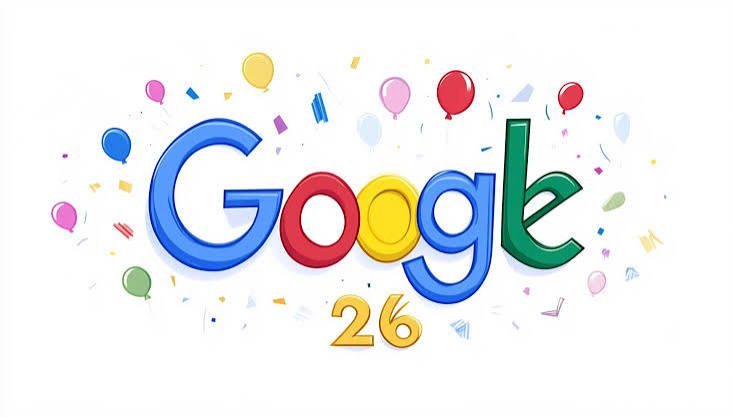
For internet users, Google’s birthday is often easiest to recognize when the normal Google logo is replaced by a special birthday Doodle. These designs can feature cakes, balloons, games, animations, historical themes, or other creative elements connected with the occasion.
The birthday celebration also gives people an opportunity to look back at how dramatically the internet has changed since the late 1990s. At that time, search engines were still developing, the web contained far less information than it does today, and using the internet was very different from the experience people have with smartphones and modern search services.
How Google Started
The history of Google began at Stanford University in California during the 1990s. Larry Page and Sergey Brin met while studying at Stanford and eventually began working together on a research project involving the structure of the World Wide Web.
Their research focused on a simple but important question: how could a search engine determine which webpages were actually useful and important? At the time, search engines generally relied heavily on information contained directly on webpages. Page and Brin believed that the relationships between webpages could provide additional information about the importance of a page.
They developed a system that examined links between websites. The basic idea was that a link from one webpage to another could be treated somewhat like a citation in academic research. If important webpages linked to another page, that page could potentially be considered more important or relevant.
The project became known as BackRub. The name referred to the system’s ability to analyze backlinks, meaning links pointing toward a webpage. BackRub was an early step toward the technology that would eventually become the foundation of Google Search.
The project required significant computing resources. Page and Brin worked with relatively inexpensive hardware and built systems that could process large amounts of web information. Their approach was unconventional for the time, but it allowed them to experiment with a different way of organizing search results.

The Story of BackRub
BackRub was not simply an early version of Google with a different name. It represented an important research experiment into how information on the web could be organized.
Larry Page was particularly interested in the structure of the World Wide Web. Because webpages were connected through hyperlinks, he considered whether those connections could reveal information about the importance of individual pages.
Sergey Brin brought strong mathematical and analytical skills to the project. Together, they developed methods for analyzing links and ranking webpages. Their work eventually contributed to the creation of PageRank, an algorithm that became closely associated with Google’s early search technology.
The name BackRub eventually disappeared, but the underlying concept remained important. Instead of simply looking for words on webpages, the system attempted to understand the relationships between webpages.
This approach helped distinguish Google from many competing search engines of the period. The goal was not merely to find pages containing a particular keyword, but to provide results that were more useful and relevant to the person searching.
The Creation of PageRank
One of the most important developments in Google’s early history was PageRank. The system was designed to evaluate the importance of webpages by examining links between them.
The name PageRank is partly connected with Larry Page’s surname, although the concept itself focused on ranking pages. The system treated links as signals that could help determine the relative importance of webpages.
The idea was influenced by the way academic citations work. In academic research, a paper that is frequently cited by other important papers may be considered influential. Page and Brin applied a similar concept to the web by analyzing links between webpages.
PageRank was not the only technology used by Google Search, but it became one of the key ideas behind the early search engine. It helped Google produce results that many users found more useful than the results offered by some existing search services.
The development of PageRank also demonstrated an important characteristic of Google’s early approach: the company was interested in using mathematical and technological methods to organize the enormous amount of information appearing on the rapidly expanding internet.
Why Was It Called Google?
The name Google is closely associated with the mathematical word “googol.” A googol is the number one followed by 100 zeros.
The enormous size represented by a googol was a fitting idea for a company whose goal involved organizing huge amounts of information. The name suggested scale and the vast quantity of information that could exist on the internet.
Google was eventually chosen as the name of the search engine and company. The name was short, memorable, and distinctive, which helped it develop into one of the most recognizable brand names in the world.
Over time, the word Google became more than a company name. “Google” also became commonly used as a verb to describe searching for information on the internet. This was a reflection of how closely the company became associated with online search.
The transition from BackRub to Google was therefore an important moment in the company’s development. The new name represented a move from a university research project toward a broader technology venture.
Google.com Was Registered Before the Company Was Incorporated
One interesting fact about Google’s history is that the Google.com domain was registered before Google Inc. officially existed as a company.
The Google.com domain was registered on September 15, 1997. This happened roughly a year before Google was officially incorporated.
This distinction is important because people sometimes assume that Google’s company birthday, domain registration date, and search-engine launch date are all the same. They are not.
The domain registration showed that the Google name was already being used for the project before the company was formally established. During this period, Page and Brin were still developing their technology and considering what to do with it.
The following year would become a turning point. Instead of remaining only a university research project, Google would become a formal company and begin its journey toward becoming a major internet business.
Google Became a Company in 1998
Google Inc. was officially established in September 1998. This is the year most closely associated with the beginning of Google as a company.
Before Google became a formal business, Page and Brin had been developing their search technology while at Stanford. They initially considered licensing or selling the technology rather than necessarily building a major company around it.
That situation changed when investors and technology figures began recognizing the potential of the search engine. One of the most important early investments came from Andy Bechtolsheim, a co-founder of Sun Microsystems.
Bechtolsheim provided a $100,000 check to support Google. The investment helped Page and Brin move forward with establishing the company and developing their technology.
Google’s early funding eventually expanded beyond that initial investment. The company attracted additional financial support from investors, friends, and family as it began building a business around its search technology.
Google’s First Garage Office
Google is famous for its garage beginnings. After becoming a company, the young business operated from a garage in Menlo Park, California.
The garage was associated with Susan Wojcicki, who later became an important executive at Google and eventually served as CEO of YouTube. At the time, the garage provided an affordable and practical place for the young company to work.
The image of Google beginning in a garage became part of the company’s larger story of rapid technological growth. Many successful technology companies have been associated with humble beginnings, but Google’s garage story became particularly famous because of how large the company eventually became.
The early office was very different from the enormous technology campuses associated with Google today. The company had a small team, limited resources, and a search engine that was still in its early stages.
Despite these limitations, the team was focused on improving search. The company’s early growth demonstrated that a relatively small group could build technology capable of influencing how people interacted with the internet.
The First Google Server
Another unusual fact from Google’s early history is that one of its early servers was built using Lego pieces.
Larry Page had an interest in building and experimenting with hardware, and the early Google team used inexpensive and unconventional solutions while developing its infrastructure.
The Lego server housing became one of the most memorable stories from Google’s early days. It represented the practical approach of a young company that needed to build computing infrastructure without the enormous resources available to major technology companies.
As Google grew, of course, its infrastructure became dramatically more sophisticated. The company eventually developed large-scale data centers and advanced computing systems capable of processing enormous amounts of information.
The early Lego server therefore became a symbol of how far Google’s technology infrastructure had developed from its original experimental beginnings.
The First Google Search Results
Google’s early search engine was designed around the idea of providing relevant results rather than simply displaying webpages that contained the searched words.
This difference was important during a period when the internet was expanding quickly. Users needed better ways to find information, and search engines competed to determine how webpages should be ranked.
Google’s clean interface also helped it stand out. The main page was relatively simple, with a search box and minimal distractions. This simplicity made it easy for users to understand what to do.
The company’s focus on search quality became central to its identity. Even as Google later expanded into many other areas, search remained one of its most important products.
The simplicity of the early Google homepage also became part of its visual identity. While many websites of the late 1990s were becoming increasingly crowded, Google maintained a relatively straightforward design focused on search.
The First Google Doodle
Google Doodles are now one of the company’s most recognizable traditions. A Doodle is a special version of the Google logo that can commemorate a person, event, holiday, cultural moment, or other occasion.
The first Google Doodle appeared in 1998, before Google had even been formally incorporated. It was created as a simple message to users indicating that the company’s founders were away attending the Burning Man festival.
The original design was very different from the elaborate interactive Doodles that people see today. It featured a simple stick figure placed behind the Google logo.
The concept eventually developed into a major part of Google’s culture. Doodles have since been used to recognize scientists, artists, historical figures, holidays, sporting events, anniversaries, and many other subjects.
Google Doodles also became a way for the company to make its homepage more interactive and culturally relevant. For millions of users, seeing a new Doodle became a reason to discover an unfamiliar person, event, or historical story.
Google’s Birthday Doodles
Google’s birthday has been celebrated through special Doodles for many years. These birthday designs often include cakes, balloons, presents, party decorations, games, or other visual elements.
The birthday Doodle tradition became an annual reminder of Google’s history and growth. Rather than simply displaying the same logo every day, Google could use its homepage to create a visual celebration.
Some birthday Doodles have also incorporated interactive elements. Users may be able to click or play with the design, turning a normal search visit into a small digital celebration.
The popularity of these Doodles reflects how strongly Google’s homepage became connected with everyday internet use. For many people, the Google logo is one of the first things they see when they open a browser or search for information.
Google’s Early Growth
Google grew rapidly after becoming a company. The quality of its search results helped attract users, while the increasing popularity of the internet created a growing market for search technology.
By the end of the 1990s, Google had begun attracting attention from technology publications and internet users. The company moved beyond its initial garage environment and continued expanding its operations.
The company also attracted major business partners. Search became an increasingly important part of the internet experience, and websites wanted to provide users with effective ways to find information.
Google’s growth was not based only on the search page itself. The company developed a business model that allowed it to generate revenue while continuing to offer search to users without charging them for ordinary searches.
This model became an important foundation for Google’s future expansion.
Google and Online Advertising
Advertising eventually became a major part of Google’s business. Instead of charging people directly for ordinary web searches, Google developed advertising systems that connected businesses with people searching for relevant products, services, and information.
This model helped transform search into a powerful digital advertising platform.
Google’s advertising products evolved significantly over time. Businesses could pay to appear in relevant search contexts, while Google could use its understanding of search queries to deliver advertisements related to what users were looking for.
The development of search advertising helped provide financial resources for Google’s continued expansion into new technologies and products.
The advertising business also changed the broader internet economy. Search engines became not only tools for finding information but also important marketplaces connecting users and businesses.
Google in the Early 2000s
The early 2000s were a major period of expansion for Google. The company continued improving its search engine while adding new features and services.
Google Images became an important addition, allowing users to search for pictures and visual information. Google also expanded into other forms of online information, gradually moving beyond the original concept of webpage search.
During this period, Google developed a reputation for innovation. The company experimented with different services and technologies, many of which eventually became important parts of everyday digital life.
Google also expanded internationally. As internet use grew around the world, the company made its services available to users in more countries and languages.
This international expansion helped transform Google from a Silicon Valley startup into a global technology company.
The Arrival of Gmail
One of Google’s major products outside traditional web search was Gmail, the company’s email service.
Gmail launched in 2004 and attracted attention because of its large storage capacity and web-based design. At a time when email storage limits were often relatively small, Gmail’s approach to storage was notable.
Gmail also introduced features designed to make managing large numbers of messages easier. Conversations could be grouped together, making it simpler to follow ongoing email exchanges.
Over time, Gmail became one of the world’s major email platforms. It also became an important part of Google’s broader ecosystem.
The development of Gmail demonstrated that Google was no longer only a search company. It was increasingly building a collection of online services that users could access through their Google accounts.
Google Maps and Digital Navigation
Google Maps became another important part of Google’s expansion.
Digital mapping changed the way people searched for locations, businesses, streets, and directions. Instead of relying only on printed maps, users could access maps through computers and later through smartphones.
Google Maps eventually developed features such as satellite imagery, street-level imagery, business information, route planning, traffic information, and location-based services.
The service also became valuable for businesses because companies could appear in local search results and provide information such as addresses, opening hours, and contact details.
Maps therefore expanded the meaning of Google Search. Users were no longer searching only for webpages. They were also searching for physical locations and real-world information.
Google and YouTube
Google expanded further when it acquired YouTube in 2006.
YouTube had already become a major platform for online video, and the acquisition brought video into Google’s growing collection of internet services.
YouTube eventually became one of the world’s most important destinations for online video. People use it for entertainment, education, news, tutorials, music, livestreams, and many other types of content.
The combination of Google Search and YouTube created two enormous ways for people to discover information online. A person looking for an answer might find a webpage through Google Search or a video through YouTube.
The acquisition demonstrated Google’s willingness to invest in services that could become important parts of the internet beyond traditional search.
Google and Android
Another major development in Google’s history was Android.
Android became one of the world’s most widely used mobile operating systems. Its growth helped Google bring its services into smartphones and other mobile devices.
Search, Gmail, Maps, YouTube, Google Play, and other services became increasingly integrated into mobile experiences.
The growth of smartphones also changed how people interacted with Google. Searching was no longer limited to desktop computers. People could search while traveling, shopping, working, studying, or simply using their phones at home.
Mobile technology therefore expanded Google’s reach dramatically and helped make online information available almost everywhere.
Google Chrome
Google Chrome was launched in 2008 as a web browser.
A browser is the software people use to access websites, and Chrome became an important part of Google’s technology ecosystem.
Chrome was designed with an emphasis on speed, simplicity, security, and modern web technologies. Its growth gave Google another important way to interact with users and the web itself.
The browser also supported Google’s broader strategy of developing services that worked together across devices.
Over time, Chrome became one of the most widely used web browsers, strengthening Google’s role in how people access online information.
Google Drive and Cloud Services
Google also expanded into cloud-based productivity and storage services.
Google Drive gave users a way to store files online and access them from different devices. It also worked closely with services such as Google Docs, Sheets, and Slides.
Cloud-based tools changed the way people worked with documents. Instead of keeping every file on one computer, users could store information online and access it from multiple locations.
Collaboration also became easier. Multiple people could work on documents and spreadsheets without relying entirely on traditional file-sharing methods.
These services helped Google become part of everyday work and education, not just internet searching.
Google’s Changing Logo
Google’s logo has changed several times throughout the company’s history.
The early logo had a distinct style that reflected the design trends of the late 1990s. Designer Ruth Kedar played an important role in developing the recognizable Google logo that became associated with the company during its early growth.
The logo used a combination of primary colors and a playful design. This visual identity helped make Google appear approachable and recognizable.
In 2015, Google introduced another major logo redesign. The company moved toward a cleaner, modern sans-serif design known as Product Sans.
Although the logo changed, Google maintained its familiar color palette. The continued use of recognizable colors helped preserve the connection between the modern logo and the company’s earlier identity.
Why Google Became So Recognizable
Google’s recognition did not come from one single product or design choice. It developed through a combination of search technology, simplicity, branding, advertising, and a rapidly expanding collection of services.
The Google homepage remained relatively simple compared with many other websites. The search box was the central feature, making the purpose of the website immediately clear.
The company also developed a playful identity through Doodles, unusual projects, colorful branding, and creative technology demonstrations.
As Google services became part of everyday life, the company name became increasingly familiar. People began using Google to search for information, check email, find directions, watch videos, store files, and use smartphones.
The result was a brand that became closely associated with the internet itself.
Google’s Parent Company Alphabet
In 2015, Google underwent a major corporate restructuring and became part of a larger holding company called Alphabet.
Alphabet was created to organize Google and several other businesses and projects under a broader corporate structure.
Google remained the name associated with its major internet products, including Search, YouTube, Android, Maps, Chrome, Gmail, and other services.
The restructuring allowed the company to separate its core internet businesses from various experimental or specialized projects.
This change was another major milestone in Google’s history because it reflected how much the organization had grown since its beginnings as a small search-engine startup.
Google and Artificial Intelligence
Artificial intelligence has become an increasingly important part of Google’s technology strategy.
Google has invested heavily in machine learning and artificial intelligence research. These technologies can help systems understand language, recognize images, interpret speech, recommend content, and improve search results.
Google’s AI research has included major developments in areas such as natural language processing, computer vision, robotics, and machine learning.
Artificial intelligence has also become increasingly connected with Google Search. Modern search systems can interpret the meaning and context of queries rather than relying only on exact keyword matches.
This represents a major evolution from the early days of BackRub, when the central challenge was understanding links between webpages.
Google Search Today
Google Search has changed enormously since the late 1990s.
The early search engine was primarily focused on finding webpages. Modern search can provide information from many different formats, including websites, images, videos, maps, news, shopping information, and other specialized results.
Search engines also need to understand increasingly complex questions. Users may type conversational questions rather than simple keywords.
Google has responded by developing systems designed to better understand natural language and user intent.
Despite all these changes, the basic purpose remains familiar: helping users find information online.
Interesting Facts About Google’s Birthday
One interesting fact about Google’s birthday is that the company has not always celebrated on exactly the same September date. September 27 eventually became the traditional birthday date, but other September dates have been used for birthday celebrations in the past.
Another interesting fact is that Google.com was registered in 1997, before the company was officially incorporated in 1998. This creates a distinction between the birth of the domain, the development of the search technology, and the formal creation of the company.
Google also began with a very small team. Its early environment was nothing like the massive global organization that exists today.
The company’s first Doodle appeared in 1998 and was created as a simple way of telling visitors that the founders were away at Burning Man. What started as a basic announcement eventually developed into the worldwide Google Doodle tradition.
Another memorable fact is that early Google hardware included Lego components. The story is often remembered as an example of how the company used creative and inexpensive solutions while building its first infrastructure.
Google’s 25th Birthday
Google celebrated its 25th birthday in 2023.
The anniversary provided an opportunity to look back at the company’s development from a small search project into a global technology organization.
The 25-year milestone highlighted major developments including Search, Gmail, Maps, YouTube, Android, Chrome, Google Drive, and many other products.
The anniversary also reminded users that the modern internet is very different from the internet of 1998. Websites, smartphones, social media, cloud computing, streaming video, artificial intelligence, and online services have transformed the way people use technology.
Google’s development is closely connected with many of these changes because the company became involved in several major areas of the digital economy.
How Google Changed Internet Search
Before Google became dominant, internet users had several search engines and directories to choose from. Finding useful information could be difficult because the web was already expanding rapidly.
Google’s ranking technology helped address part of this problem by considering relationships between webpages.
The company also focused strongly on speed and simplicity. Users could enter a query and quickly receive a list of results without navigating through complicated menus.
Over time, Google improved its ability to understand spelling, language, location, images, videos, and other types of information.
These developments helped make search engines a central part of everyday internet use.
Google’s Influence on Everyday Life
Google’s influence extends far beyond the search box.
People use Google services to communicate through Gmail, navigate through Maps, watch videos through YouTube, access files through Drive, browse the web through Chrome, use mobile devices through Android, and search for information through Google Search.
Students use Google services for research and education. Businesses use them for advertising, communication, collaboration, analytics, and online visibility.
Travelers use Maps for directions and location information. Creators use YouTube to publish videos. Developers use Google technologies to build applications and services.
Because of this broad ecosystem, Google has become deeply connected to many ordinary digital activities.
Google’s Birthday and Google Doodles
Google Doodles are particularly important to the birthday tradition because they turn an ordinary search homepage into a celebration.
The designs can be simple or highly interactive. Some are static illustrations, while others may include animation, music, games, or educational experiences.
Doodles have also become a way for Google to highlight people and events that may not otherwise receive worldwide attention.
For users, a Doodle can be both entertaining and educational. Someone who notices an unfamiliar person represented in the logo may click the Doodle and learn about that person’s work or historical significance.
The Doodle tradition therefore reflects one of the most recognizable characteristics of Google: combining information with an approachable and creative presentation.
From a Research Project to a Global Company
Google’s history demonstrates how a university research project can develop into a global technology organization.
Larry Page and Sergey Brin began with a question about how to organize information on the growing World Wide Web. Their experiments with links and webpage ranking produced technology that eventually became the foundation of Google Search.
The company then expanded through advertising, new products, acquisitions, international growth, mobile technology, cloud services, video, artificial intelligence, and many other areas.
Each stage added another layer to the company’s ecosystem.
The transformation is especially striking when the modern organization is compared with its early beginnings. The original project involved a small group of researchers working with limited resources, while modern Google operates technology used by billions of people around the world.
Why Google’s Birthday Still Matters
Google’s birthday matters because it represents more than the anniversary of a company. It marks a major chapter in the history of the internet.
The web existed before Google, and many other companies contributed to its development. However, Google played a major role in making the enormous amount of information on the web easier for ordinary users to discover.
Its history also illustrates how technology can evolve. A system designed to rank webpages eventually became part of a much larger ecosystem involving search, email, maps, video, mobile devices, browsers, cloud computing, and artificial intelligence.
Every September, the birthday celebration gives users a chance to remember how different the digital world was when Google began.
From BackRub and university research to a global technology ecosystem, Google’s journey covers some of the most important developments in modern computing and internet history.
Conclusion
Google’s birthday is traditionally celebrated on September 27, but the complete story of Google began several years earlier. Larry Page and Sergey Brin started developing their search technology at Stanford in 1996, creating an early system known as BackRub. Their research into links between webpages eventually contributed to PageRank and the foundation of Google Search.
The Google.com domain was registered in 1997, and Google Inc. was officially established in 1998. The company began with a small team, limited resources, a garage office, and an unconventional approach to computing infrastructure. Its early success came from a focus on organizing information and providing useful search results.
Google then expanded far beyond its original search engine. Gmail, Maps, YouTube, Android, Chrome, Drive, and many other products helped transform the company into a major part of the modern digital world. At the same time, Google Doodles became a unique way to celebrate people, events, holidays, and milestones, including Google’s own birthday.
The history of Google is therefore a story of continuous development. From a research project and a small startup to a global technology organization, the company has experienced major changes while maintaining search as one of its central services.
When people see a special Google birthday Doodle on September 27, it is more than a colorful change to a familiar logo. It represents the history of a company that began with an attempt to organize the growing web and eventually became one of the most recognizable names in internet history.
For More Information About Article, Click Here.
For More Articles, Click Here.