
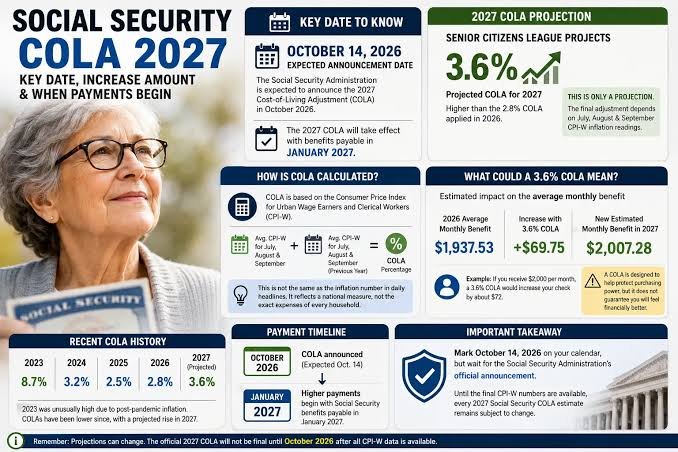
The 2027 Social Security COLA is especially important because inflation continues to affect household budgets. Even when inflation slows, the prices of many everyday goods and services can remain much higher than they were several years ago. Retirees who rely heavily on fixed monthly income may therefore find it difficult to balance their expenses, particularly when healthcare, housing, food, and energy costs rise faster than their available income.
As of October 13, 2026, forecasts from retirement and senior advocacy organizations suggest that the 2027 COLA could be approximately 3.4% to 3.6%. The official announcement is expected on October 14, 2026, after the relevant inflation data becomes available. Until the Social Security Administration (SSA) confirms the adjustment, these figures should be treated as estimates rather than a guaranteed increase.
Along with the expected COLA, beneficiaries should understand how Social Security payment dates work, when the higher benefit amount may begin, how Supplemental Security Income (SSI) differs from retirement benefits, and why the amount deposited into a bank account may not increase by the full COLA percentage. This guide explains the key information people need to prepare for Social Security benefits in 2027.

1. What Is Social Security?
Social Security is a federal program in the United States that provides financial benefits to eligible workers and their families. It is administered by the Social Security Administration and primarily funded through payroll taxes collected under the Federal Insurance Contributions Act (FICA) and the Self-Employment Contributions Act (SECA). Workers generally contribute during their careers, and their earnings records help determine eligibility and benefit amounts.
The program provides several types of benefits. Retirement benefits support eligible workers who have reached an age at which they can claim retirement income. Social Security Disability Insurance (SSDI) provides benefits to qualifying workers who have a qualifying disability and meet the program’s work-credit requirements. Survivors benefits can help eligible spouses, children, and other qualifying family members after a covered worker dies.
Supplemental Security Income is a separate federal program administered by the SSA. It provides financial assistance to eligible older adults and people who are blind or disabled and have limited income and resources. Unlike standard Social Security retirement benefits, SSI eligibility is primarily based on financial circumstances and qualifying age or disability criteria rather than a person’s history of payroll tax contributions.
These programs are related but have different eligibility rules, payment schedules, and benefit calculations. A person may receive retirement benefits, SSDI, survivors benefits, SSI, or in some circumstances more than one type of payment. Understanding which program applies is important when reviewing the 2027 payment calendar and estimating the effect of the COLA.
2. What Is the Social Security COLA for 2027?
The Cost-of-Living Adjustment is an annual change designed to help Social Security and SSI payments keep pace with inflation. When prices rise, the purchasing power of a fixed monthly benefit can decline. A COLA increases eligible payments according to a formula established by federal law, helping beneficiaries maintain some of their ability to pay for everyday necessities.
For 2027, recent forecasts have placed the expected adjustment in the range of approximately 3.4% to 3.6%. The estimates differ because analysts use inflation data and forecasting methods to anticipate the result before the SSA announces the official figure. A projection is useful for financial planning, but it is not the same as the final adjustment.
The official 2027 COLA announcement is expected on October 14, 2026. The final percentage is calculated using changes in the Consumer Price Index for Urban Wage Earners and Clerical Workers, commonly known as CPI-W. The SSA compares the average CPI-W for July, August, and September of the current year with the average for the third quarter of the last year in which a COLA became effective. If the formula produces an increase, the adjustment is rounded to the nearest tenth of one percent.
If the final COLA is 3.5%, for example, an eligible monthly benefit of $1,500 would increase by about $52.50 before applicable deductions. A benefit of $2,000 would increase by about $70, while a benefit of $2,500 would increase by about $87.50. These examples illustrate the calculation only; actual benefits depend on the official percentage, the beneficiary’s record, and any deductions or adjustments that apply.
The 2027 adjustment will generally become effective for Social Security benefits payable in January 2027. SSI recipients generally receive their increased payment for January at the end of December 2026 because the normal January 1 payment date falls on a federal holiday. Beneficiaries should look for their individual COLA notice or check their official SSA account for details about their new payment amount.
3. How Much Could Social Security Benefits Increase in 2027?
The amount a person receives in additional benefits depends on their current monthly payment and the final COLA percentage. Because the adjustment is calculated as a percentage, beneficiaries with larger payments generally receive a larger dollar increase, while those with smaller payments receive a smaller increase.
For planning purposes, the following examples use a hypothetical 3.5% COLA. This is an illustration, not a confirmed 2027 benefit schedule.
| Current monthly benefit | Estimated monthly increase | Estimated new monthly benefit |
|---|---|---|
| $800 | $28.00 | $828.00 |
| $1,000 | $35.00 | $1,035.00 |
| $1,200 | $42.00 | $1,242.00 |
| $1,500 | $52.50 | $1,552.50 |
| $1,800 | $63.00 | $1,863.00 |
| $2,000 | $70.00 | $2,070.00 |
| $2,500 | $87.50 | $2,587.50 |
| $3,000 | $105.00 | $3,105.00 |
The table shows the effect of applying the same percentage to different benefit amounts. The actual increase may differ because the official COLA could be higher or lower than the example. Individual payment calculations may also involve rounding and deductions.
Beneficiaries should distinguish between their gross benefit and the amount they actually receive. The gross benefit is the amount calculated before deductions. The net payment is the amount deposited into a bank account or delivered through another approved payment method after applicable deductions. Medicare premiums, tax withholding, and certain other adjustments can affect the final deposit.
For example, a person whose gross Social Security benefit increases by $70 per month might not see the full $70 reflected in their bank account if their Medicare premium or another deduction also increases. The COLA still raises the benefit calculated under Social Security rules, but changes in deductions can reduce the visible improvement in take-home income.
It is also important to remember that the COLA does not give every beneficiary the same dollar increase. A percentage-based adjustment is tied to the person’s eligible benefit amount. People with different work histories, retirement ages, disability records, or survivor-benefit circumstances may receive different monthly payments even when the same COLA applies.
4. When Will the 2027 COLA Take Effect?
The 2027 COLA is expected to affect Social Security benefits payable in January 2027. This means most beneficiaries who receive retirement, SSDI, or survivors benefits through the regular monthly schedule should see the adjusted amount in their January payment. The precise payment date depends on the beneficiary’s normal payment group.
SSI follows a slightly different calendar. SSI payments are normally scheduled for the first day of the month. When the first falls on a weekend or federal holiday, the payment is generally issued on the preceding business day. As January 1, 2027, is a federal holiday, the January SSI payment is expected to arrive on December 31, 2026.
This early SSI payment is not an additional monthly benefit. It is the January payment delivered ahead of the calendar month because the regular payment date is not a business day. Beneficiaries who receive SSI should plan their budgets accordingly, since they will not normally receive another SSI payment at the start of January.
Social Security recipients who have been receiving benefits for some time should not assume that their payment date changes because the COLA changes. The adjustment affects the amount of the benefit, not the standard payment group. A person who usually receives a payment on the third Wednesday should generally continue to follow that schedule unless the SSA provides a specific notice of a change.
Beneficiaries should review their individual COLA notices when they become available. These notices explain how the adjustment affects the person’s monthly benefit. People with a my Social Security account can also use the official online service to review benefit information and access available notices.
5. Social Security Payment Dates for 2027
Most Social Security retirement, SSDI, and survivors benefits are paid according to the recipient’s date of birth. For many beneficiaries whose benefits began after April 1997, payments are scheduled on the second, third, or fourth Wednesday of each month.
The general schedule is based on the day of the month on which the beneficiary was born. People born from the 1st through the 10th generally receive benefits on the second Wednesday. Those born from the 11th through the 20th generally receive benefits on the third Wednesday. Those born from the 21st through the 31st generally receive benefits on the fourth Wednesday.
The following calendar lists the corresponding Wednesday payment dates for 2027. It is a planning guide based on the standard monthly schedule. Beneficiaries should confirm their own payment dates through official SSA information, particularly if they receive benefits under an exception to the normal Wednesday schedule.
| Month | Birth date 1–10 | Birth date 11–20 | Birth date 21–31 |
|---|---|---|---|
| January | January 13 | January 20 | January 27 |
| February | February 10 | February 17 | February 24 |
| March | March 10 | March 17 | March 24 |
| April | April 14 | April 21 | April 28 |
| May | May 12 | May 19 | May 26 |
| June | June 9 | June 16 | June 23 |
| July | July 14 | July 21 | July 28 |
| August | August 11 | August 18 | August 25 |
| September | September 8 | September 15 | September 22 |
| October | October 13 | October 20 | October 27 |
| November | November 10 | November 17 | November 24 |
| December | December 8 | December 15 | December 22 |
For example, a beneficiary whose birthday falls on February 6 and who is covered by the standard Wednesday schedule would generally expect payment on February 10, 2027. Someone born on February 15 would generally expect payment on February 17. A person born on February 25 would generally expect payment on February 24.
These dates do not apply to every Social Security recipient. Some beneficiaries receive payments on a different schedule because of when they began receiving benefits or because they also receive SSI. For that reason, it is important to identify the correct payment category before relying on the table.
A bank may display a pending deposit before the scheduled payment date, but this depends on the financial institution and its own policies. Early availability offered by a bank is not an official change to the SSA payment schedule. Beneficiaries should plan around their scheduled date rather than assume that a deposit will always arrive early.
6. Who Receives Social Security Payments on the Third of the Month?
Some beneficiaries do not follow the second-, third-, and fourth-Wednesday schedule. People who began receiving Social Security benefits before May 1997 generally receive their Social Security payments on the third day of the month. Certain people who receive both Social Security and SSI may also receive their Social Security payment on the third day, while SSI follows its separate calendar.
When the third day of a month falls on a weekend or federal holiday, payment is generally made on the preceding business day. In January 2027, January 3 falls on a Sunday, and January 1 is a federal holiday. As a result, people covered by the third-of-the-month schedule should expect their January payment on December 31, 2026, under the standard rules.
This early payment should not be confused with an extra benefit. It is the normal monthly payment delivered earlier because of the calendar. The next payment will follow the person’s regular schedule for the following month.
The third-of-the-month rule is especially important for people who have been receiving benefits for many years. They may see news articles or online calendars listing Wednesday dates and assume those dates apply to everyone. However, the SSA maintains different payment arrangements for different groups.
If a recipient is uncertain which schedule applies, their benefit notice and official SSA account can help clarify the expected date. People should be cautious about unofficial social media posts that claim every beneficiary will receive payment on a single date or that an extra payment has been approved without an official announcement.
7. Supplemental Security Income Payment Dates in 2027
Supplemental Security Income, commonly known as SSI, is designed to assist eligible people with limited income and resources. It may support adults aged 65 or older, as well as qualifying people who are blind or disabled. Eligibility is based on program requirements, and SSI is separate from Social Security retirement benefits even though the SSA administers both programs.
SSI payments are normally scheduled for the first day of each month. When the first day falls on a Saturday, Sunday, or federal holiday, the payment is generally made on the previous business day. This means the date on which money arrives may fall in the preceding calendar month.
The expected 2027 SSI payment dates under the standard calendar are as follows:
| Benefit month | Expected payment date |
|---|---|
| January 2027 | December 31, 2026 |
| February 2027 | February 1, 2027 |
| March 2027 | March 1, 2027 |
| April 2027 | April 1, 2027 |
| May 2027 | April 30, 2027 |
| June 2027 | June 1, 2027 |
| July 2027 | July 1, 2027 |
| August 2027 | July 30, 2027 |
| September 2027 | September 1, 2027 |
| October 2027 | October 1, 2027 |
| November 2027 | November 1, 2027 |
| December 2027 | December 1, 2027 |
| January 2028 | December 31, 2027 |
This calendar explains why some recipients receive two SSI deposits in one calendar month. For example, a recipient may receive the regular May payment on April 30 and then receive the June payment on June 1. The April deposit is the May benefit, not an extra payment.
Likewise, SSI recipients may receive the January 2028 payment on December 31, 2027, because January 1 is a federal holiday. The payment is still intended to cover the January benefit month. Recipients should avoid treating two deposits in one month as a bonus, because the next month’s payment may not arrive on the first day of that month.
The timing of SSI payments is particularly important for people who manage rent, utility bills, groceries, and other recurring expenses using a fixed monthly budget. Keeping track of the benefit month rather than only the deposit month can help prevent accidental overspending before the next payment arrives.
8. Will Social Security Recipients Get an Extra Payment in 2027?
Questions about extra Social Security payments often become more common when a new COLA is announced. Some online posts describe the annual increase as a bonus, stimulus payment, or special government payment. However, the COLA is a regular adjustment to eligible benefits, not a separate bonus paid on top of the normal monthly benefit.
If the 2027 COLA is confirmed, eligible beneficiaries will generally receive a higher monthly benefit beginning with the applicable payment period. They will not automatically receive a separate one-time COLA check. The amount of the increase will depend on their individual benefit and the official percentage.
The same principle applies to SSI. An early deposit caused by a weekend or holiday is not an additional payment. It is the regular monthly benefit issued before the calendar month begins. A person who receives two SSI payments during one calendar month should check which benefit months those payments cover before making financial decisions.
Special payments can occur when a government program or law authorizes them, but beneficiaries should not assume that a new payment has been approved simply because a post circulates online. Reliable information should come from official government announcements and the recipient’s own benefit records.
People should also be careful about messages that ask them to pay a fee to unlock a Social Security increase or provide banking details to claim a supposed bonus. The annual COLA is applied through the regular benefit system. A request for payment or sensitive information from an unfamiliar source should be treated cautiously.
9. How Medicare Premiums Could Affect the 2027 Increase
Medicare costs are an important consideration for many Social Security beneficiaries, particularly retirees aged 65 and older. For people enrolled in Medicare Part B, the monthly premium is often deducted directly from their Social Security payment. This means a rise in the premium can reduce the amount of the COLA increase that remains in the beneficiary’s bank account.
The standard Medicare Part B premium for 2026 is $202.90 per month. Reports based on projections have discussed a possible increase to $209.50 in 2027, but beneficiaries should check the official Medicare announcement for the final amount. Any projection should not be treated as a confirmed premium until the responsible agency publishes the final figures.
Consider a hypothetical beneficiary whose gross Social Security benefit increases by $70 per month. If that person’s Medicare premium rises by $6.60, the net increase would be approximately $63.40, assuming no other deductions or changes. The exact result will depend on the final COLA, Medicare premium, and the person’s individual circumstances.
Not every Social Security beneficiary has Medicare premiums deducted from their payment. Some people are not enrolled in Part B, while others have their premiums paid through assistance programs. Premiums, prescription drug costs, and other healthcare expenses vary, so the impact of a COLA will not be identical for everyone.
Beneficiaries should review their Social Security benefit notice alongside any Medicare premium notice they receive. Looking at both figures provides a more realistic view of the amount available for monthly expenses. It can also help people prepare for changes in insurance costs before the new year begins.
10. Why the COLA May Not Cover Every Increase in Living Costs
The purpose of the COLA is to help Social Security payments keep pace with measured inflation. However, the adjustment does not guarantee that every beneficiary will be able to afford all expenses after prices change. Individual households spend their money differently, and the costs that matter most to one person may not match the national inflation measure.
For example, an older adult who owns a home without a mortgage may have a different budget from someone who rents an apartment. A beneficiary with frequent medical appointments may face higher healthcare expenses than someone who rarely uses medical services. People who rely on public transportation may experience a different cost pattern from those who own and maintain a car.
The CPI-W formula used for the Social Security COLA measures price changes for a specific population. Some advocates argue that an index focused more directly on older adults’ spending patterns could better reflect the expenses faced by many retirees. Healthcare, housing, utilities, food, and insurance are frequent concerns in these discussions.
A 3.5% increase, for example, raises a $2,000 monthly benefit by $70 before deductions. If a person’s rent, insurance, groceries, and other essential expenses increase by more than that amount, their budget may remain under pressure even after the COLA takes effect. Conversely, someone whose major expenses remain stable may experience more noticeable relief.
For this reason, the COLA should be viewed as one part of financial planning rather than a complete solution to rising living costs. Beneficiaries may benefit from reviewing their spending, comparing insurance options when appropriate, and planning for predictable annual expenses.
11. How to Check Your New Social Security Benefit Amount
The SSA provides official information that beneficiaries can use to review their benefits and understand the effect of the annual COLA. One of the most convenient options is a personal my Social Security account, which allows eligible users to access their records and use available online services.
Once the official adjustment is announced, beneficiaries should look for the notice explaining their new benefit amount. The notice can help them understand how the COLA changes their monthly payment. If they receive both Social Security and SSI, they should review the information for each program rather than assume the calculations and payment dates are identical.
People who do not use online services can review official notices sent by the SSA and contact the agency through its established channels if they need assistance. Keeping personal information current is also important. Incorrect mailing details or outdated account information can make it harder to receive notices and resolve benefit questions.
Beneficiaries should never share their Social Security number, account password, or banking information with an unknown person claiming to be an SSA representative. Official benefit information should be accessed through trusted government channels, and suspicious messages requesting immediate action should be checked before responding.
Checking the actual benefit notice is more reliable than using a general COLA calculator alone. Calculators can help estimate a possible increase, but they cannot necessarily account for every deduction, benefit rule, or individual circumstance.
12. How Beneficiaries Can Prepare for Social Security in 2027
Preparing for the new benefit year begins with understanding current income and expenses. Beneficiaries can make a simple monthly budget that includes housing, utilities, groceries, transportation, insurance, healthcare, debt payments, and other necessary costs. Comparing that budget with their current income can reveal where a change in prices may create financial pressure.
It is sensible to estimate the possible COLA using a few different percentages rather than relying on one forecast. For example, a beneficiary can calculate what a 3.4%, 3.5%, or 3.6% adjustment would mean for their current payment. Once the official percentage and new benefit amount are available, the estimate can be replaced with the confirmed figure.
People should also plan around the actual payment schedule. SSI recipients whose January payment arrives on December 31, 2026, need to remember that the deposit is intended for January. Similarly, an SSI payment made at the end of April 2027 is intended to cover May. Tracking benefit months can help avoid spending money too early.
It may also be useful to review recurring expenses before the new year. Beneficiaries can check utility bills, insurance premiums, subscription charges, and other regular payments to identify costs that can be reduced without sacrificing essential services. Even small monthly savings can help when a household operates on a limited income.
Finally, beneficiaries should keep copies of their benefit notices and confirm important changes through official channels. A clear record of monthly income, deductions, and payment dates makes it easier to identify unexpected changes and ask the SSA relevant questions.
13. What to Do if a Social Security Payment Is Late
A payment that does not appear on the expected date can be stressful, especially when rent or other bills are due. However, a missing deposit does not automatically mean that benefits have been stopped. Processing issues, bank delays, outdated account details, and other circumstances can affect when a payment becomes available.
Beneficiaries should first check the normal payment date for their benefit category. Someone who follows the Wednesday schedule should not expect the payment on the first day of every month. SSI recipients should also account for payments moved to the preceding business day when the first falls on a weekend or federal holiday.
If a payment has not arrived, the recipient can check their bank account and review any messages or notices from the SSA. Under the agency’s general guidance, people who do not receive a payment on the expected date should allow three additional mailing days before contacting Social Security. For direct deposits, beneficiaries should also ask their financial institution whether a deposit is pending or whether there is an account-related problem.
If the payment remains missing, the recipient should contact the SSA through official channels and provide the information needed to identify the payment. They should keep notes about the expected date, the amount, and any communication with the bank or agency. This can help make the issue easier to resolve.
Beneficiaries should avoid paying a third party who promises to recover a missing Social Security payment. Payment problems should be addressed through the SSA and the financial institution involved, not through unfamiliar services demanding an upfront fee.
14. Frequently Asked Questions About Social Security Benefits in 2027
What is the expected Social Security COLA for 2027?
As of October 13, 2026, forecasts suggest a COLA of approximately 3.4% to 3.6%. The official announcement is expected on October 14, 2026. Until the SSA confirms the final percentage, the estimates should be considered provisional.
When will the 2027 COLA begin?
The adjustment is expected to affect Social Security benefits payable in January 2027. SSI recipients generally receive their January payment at the end of December 2026 because January 1 is a federal holiday.
How much more money could I receive?
The increase depends on the size of your current benefit and the official COLA. If the adjustment were 3.5%, a $1,500 monthly benefit would increase by about $52.50 before deductions, while a $2,000 benefit would increase by about $70.
Will everyone receive their Social Security payment on the same date?
No. Many beneficiaries receive payments on the second, third, or fourth Wednesday based on their date of birth. Some people who began receiving benefits before May 1997, along with certain recipients of both Social Security and SSI, follow a different schedule.
Why does my SSI payment sometimes arrive before the month begins?
SSI payments are normally scheduled for the first day of each month. If that day is a weekend or federal holiday, the payment is generally issued on the previous business day. The early deposit covers the upcoming benefit month and is not an extra payment.
Can my Medicare premium reduce the effect of the COLA?
Yes. If Medicare Part B premiums are deducted from your Social Security payment and the premium increases, the additional deduction can reduce the amount of the COLA increase reflected in your net deposit. The effect depends on your individual benefit and deductions.
Is the 2027 COLA guaranteed to be 3.5%?
No. A 3.5% adjustment is an estimate used in examples and forecasts. The official COLA must be announced by the SSA after the required inflation data is available.
Conclusion
Social Security benefits in 2027 will be shaped by the annual Cost-of-Living Adjustment, individual benefit calculations, and the regular payment calendar. As of October 13, 2026, forecasts suggest that the COLA could fall between 3.4% and 3.6%, with the official announcement expected on October 14. The final percentage will determine how much eligible benefits increase for the new year.
For beneficiaries, the practical impact will depend on more than the COLA percentage alone. The amount of the existing benefit, Medicare premiums, other deductions, personal living costs, and the timing of payments can all affect household finances. Understanding these factors can help people set realistic expectations and prepare a workable budget for 2027.
Beneficiaries should confirm their individual benefit amounts and payment dates through official SSA information once the new figures are available. By keeping track of the payment calendar, understanding the difference between Social Security and SSI, and planning around the actual amount deposited, recipients can approach the new benefit year with clearer expectations and fewer surprises.
For More Information About Article, Click Here.
For More Articles, Click Here.